
February 2025
| Model | WAVEWATCH III 6.07 |
| Forecast horizon | 10 days |
| Spatial resolution | 0.5 degree (~50 km) |
| Temporal resolution | 1 hourly (spectra), 3 hourly (grid) |
| Region | Global (0E - 359.5E, 77.5S - 77.5N) |
| Forcings | GFS (6-hourly) / ECMWF (12-hourly) winds |
The Oceanum global wave forecast provides 10-day predictions of wave conditions across all ocean basins (Figure 1). Wave fields are produced using the WAVEWATCH III (WW3) third-generation spectral wave model at 0.5-degree resolution. The forecast is run operationally with both GFS (updated 6-hourly) and ECMWF (updated 12-hourly) atmospheric forcing.
Wind forcing is provided by NOAA GFS at 0.25-degree resolution or ECMWF IFS at 0.25-degree resolution. Sea ice concentration is obtained from GFS for both model configurations. Bathymetry is derived from GEBCO 2020.
The modelling setup employs the ST4 source term parameterisations with calibrated parameters for global wave climate representation. Spectra are discretised into 24 directional bins and 31 frequency bins, covering a frequency range from 0.037 to 0.71 Hz with 10% logarithmic increments.
The dataset provides hourly estimates for key ocean wave parameters (Table 2) including spectral quantities integrated over the full spectrum and for spectral partitions. Partitions are defined from an 8-second split (sea/swell) and from the Watershed method, which identifies one wind-sea partition and up to two swell partitions. Frequency-direction wave spectra are available at strategically selected sites worldwide (black dots in Figure 1). Nowcast datasources are also provided, constructed from the most recent data in each forecast cycle to form continuous time series.
The global forecast is well suited for deep water wave predictions anywhere on the planet. A key application is providing directional spectral boundary conditions for downscaling regional and coastal wave models. The spectra output network is designed with variable density, ranging from 2 degrees in deep water to 0.5 degrees near coastlines, ensuring appropriate resolution for boundary forcing across diverse modelling applications. The spectral data is optimised for very fast access (seconds to a few minutes), enabling efficient operational workflows.
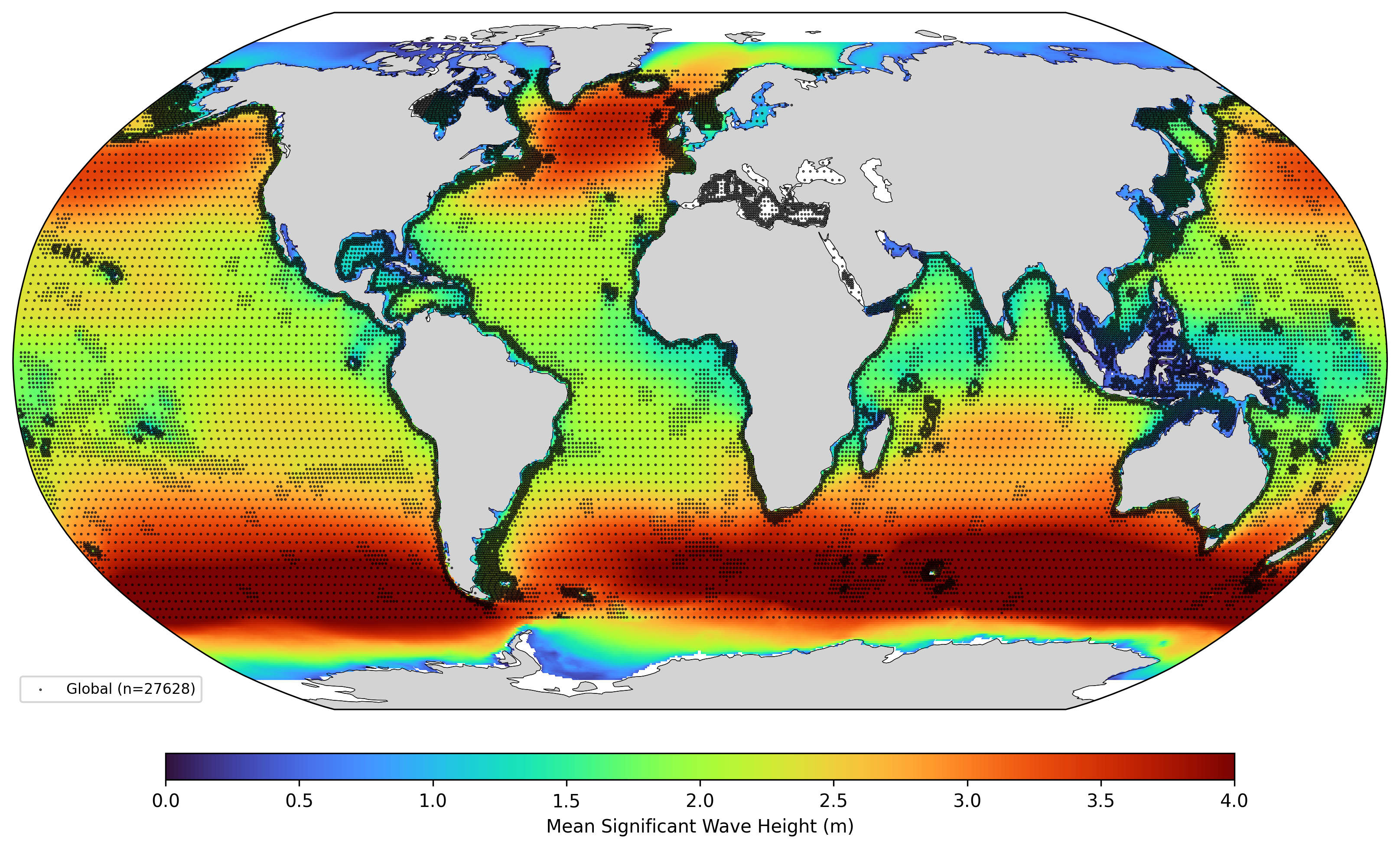
Figure 1. Mean significant wave height (Hs) over the global domain from the Oceanum ERA5 wave hindcast (1979-2020). Black dots indicate spectra output locations.
The global wave model configuration has been validated against satellite altimeter observations from multiple missions including Jason-2, Jason-3, Sentinel-3A, and Sentinel-3B. Validation statistics demonstrate excellent agreement with observed wave heights across all ocean basins. Detailed validation results are available in the hindcast specification document.
Interactive validation results are available through the Oceanum Validation App.
Table 1. Data description.
| Field | Value |
|---|---|
| Title | Oceanum global wave forecast |
| Institution | Oceanum |
| Access | Oceanum Datamesh |
| Source | WAVEWATCH III 6.07 |
| Source terms | ST4 |
| Forecast horizon | 10 days |
| Temporal resolution | 1 hourly (spectra), 3 hourly (grid) |
| Spatial coverage | Global (0E - 359.5E, 77.5S - 77.5N) at 0.5 degree |
| Frequency discretisation | 31 frequencies between 0.037 - 0.71 Hz at 10% logarithmic increments |
| Direction resolution | 15 deg |
| Bathymetry | GEBCO 2020 |
| Winds (GFS) | NOAA GFS (6-hourly updates) |
| Winds (ECMWF) | ECMWF IFS (12-hourly updates) |
| Sea ice | GFS sea ice concentration |
Integrated wave parameters are stored 3-hourly over the domain at the native model resolution. Table 2 describes long names and units of key gridded output parameters.
Table 2. Gridded output parameters.
Variable names link to the corresponding NERC Vocabulary Server standard name where available. All parameters are defined on the time, latitude and longitude coordinates.
| Variable | Long Name | Units |
|---|---|---|
| dir | mean wave direction | degree |
| dp | peak wave direction | degree |
| dpt | depth below sea surface | m |
| fp | peak frequency | Hz |
| hs | significant height of wind and swell waves | m |
| ice | sea ice concentration | - |
| lm | mean wave length | m |
| MAPSTA | status map | - |
| pdir0 | mean direction of wind waves (partition 0) | degree |
| pdir1 | mean direction of primary swell waves (partition 1) | degree |
| pdir2 | mean direction of secondary swell waves (partition 2) | degree |
| pdp0 | peak direction of wind waves (partition 0) | degree |
| pdp1 | peak direction of primary swell waves (partition 1) | degree |
| pdp2 | peak direction of secondary swell waves (partition 2) | degree |
| phs0 | significant height of wind waves (partition 0) | m |
| phs1 | significant height of primary swell waves (partition 1) | m |
| phs2 | significant height of secondary swell waves (partition 2) | m |
| pt02c0 | mean period T02 partition 0 | s |
| pt02c1 | mean period T02 partition 1 | s |
| pt02c2 | mean period T02 partition 2 | s |
| ptp0 | peak period of wind waves (partition 0) | s |
| ptp1 | peak period of primary swell waves (partition 1) | s |
| ptp2 | peak period of secondary swell waves (partition 2) | s |
| pws0 | wind sea fraction of partition 0 | - |
| pws1 | wind sea fraction of partition 1 | - |
| pws2 | wind sea fraction of partition 2 | - |
| spr | mean directional spread | degree |
| t02 | mean wave period (Tm0,2) | s |
| tp | peak wave period | s |
| uwnd | eastward wind component at 10m | m/s |
| vwnd | northward wind component at 10m | m/s |
Frequency-direction wave spectra are stored hourly at the spectra output sites within the domain. Table 3 describes the spectra output variables, using the exact variable names served by Datamesh.
Table 3. Spectra output variables.
Variable names link to the corresponding NERC Vocabulary Server standard name where available. Spectra are defined on the time, site, freq and dir coordinates; lon and lat are per-site data variables giving each site’s location.
| Variable | Long Name | Units |
|---|---|---|
| efth | sea surface wave variance spectral density | m² s / deg |
| dpt | water depth | m |
| wspd | wind speed | m/s |
| wdir | wind direction | degree |
| lat | latitude | degrees_north |
| lon | longitude | degrees_east |
www.oceanum.science