
October 2026
| Model | SWAN 41.31 |
| Forecast horizon | 7 days |
| Spatial resolution | 0.05 degree (~5 km) to 0.0005 degree (~50 m) |
| Temporal resolution | 1 hourly |
| Region | 112E - 117.5E, 27S - 20S |
| Forcings | GFS/ECMWF winds, Mercator/TPXO currents, and Oceanum spectra |
| Update frequency | 6-hourly (GFS) / 12-hourly (ECMWF) |
The Northwest Cape wave forecast dataset provides operational wave predictions across the Northwest Cape region of Western Australia (Figure 1). The domain encompasses the Exmouth Gulf, Ningaloo Reef, and extends south to Cape Cuvier. Wave forecasts are produced using the SWAN (Simulating WAves Nearshore) third-generation spectral wave model, with a 7-day forecast horizon.
Two forcing configurations are available: NOAA GFS updated every 6 hours (00, 06, 12, 18 UTC) and ECMWF IFS updated every 12 hours (00, 12 UTC). Ocean currents are prescribed from a combination of Mercator global ocean analysis and TPXO9 tidal atlas to capture both mesoscale circulation and tidal currents. Spectral boundary conditions are supplied by the Oceanum Global WW3 wave forecast forced with the respective wind source. Bathymetry is derived from the Australian Bathymetry and Topography 2026 250m grid.
The modelling setup employs the ST6 source term parameterisations. Spectra are discretised into 36 directional bins and 32 frequency bins, covering a frequency range from 0.037 to 0.71 Hz with 10% logarithmic increments. The model features a three-level nesting structure:
The dataset provides hourly forecast estimates for key ocean wave parameters (Table 3) including spectral quantities integrated over the full spectrum and for spectral partitions. Partitions are defined from an 8-second split (sea/swell) and from the Watershed method, which identifies one wind-forced partition and up to three swell partitions. Forecasts are archived for 7 days, and frequency-direction wave spectra are available at 126 sites in the Northwest Cape 5 km domain and at 1 site in the Cape Cuvier 50 m domain. Nowcast datasets are also available for the Northwest Cape 5 km and Cape Cuvier 50 m domains, constructed by retaining the most recent data from each forecast cycle to provide a continuous near-real-time historical record.
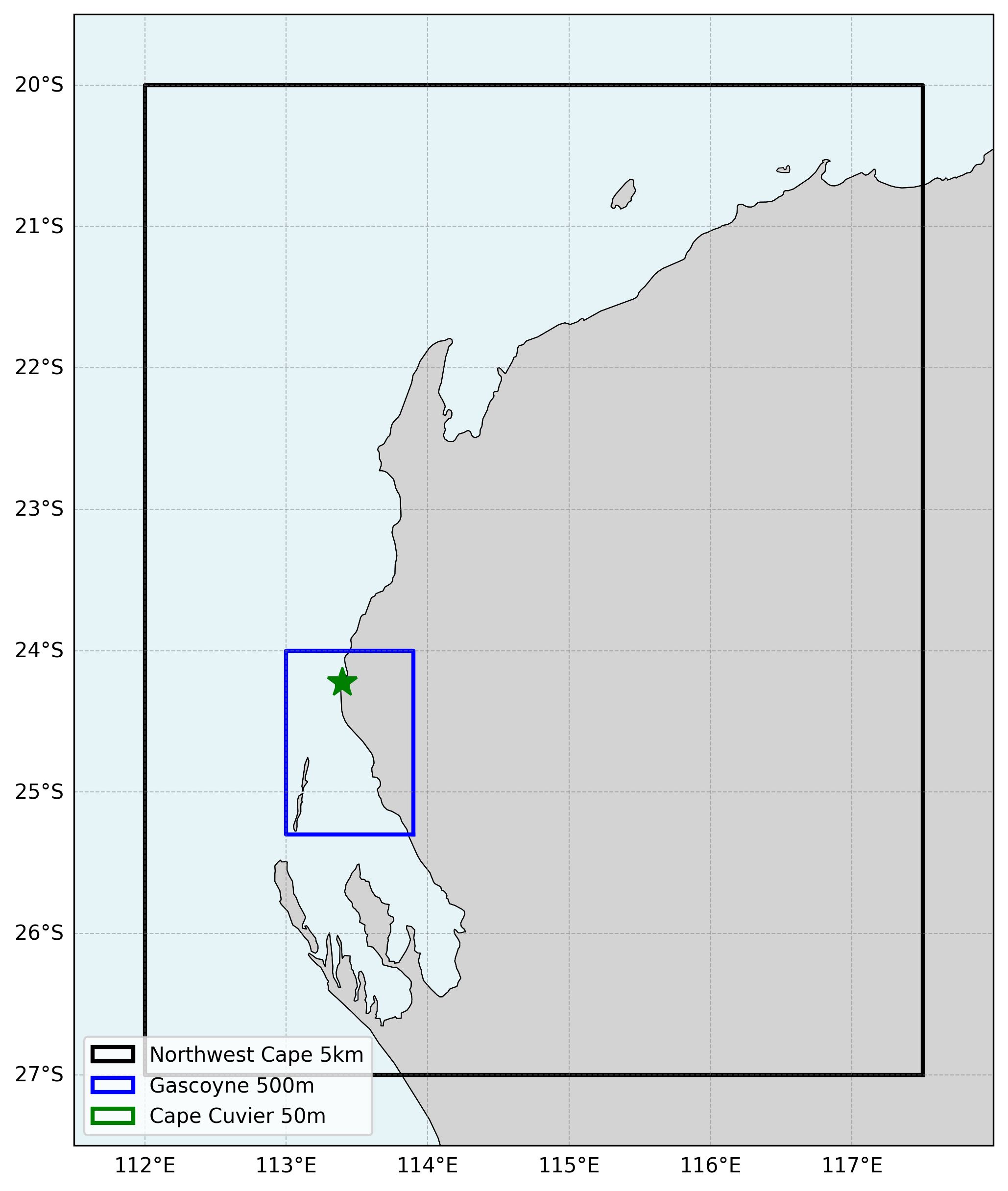
Figure 1. Northwest Cape wave forecast domain extent showing the parent 5 km domain, intermediate Gascoyne 500 m domain, and nested Cape Cuvier 50 m domain.
The wave model physics and calibration follow the same approach validated against satellite altimeter observations for Oceanum’s Australian regional hindcast domains. The ST6 source term parameterisation has been extensively validated for Southern Ocean swell and tropical cyclone conditions affecting the Northwest Cape region.
Table 1. Data description.
| Field | Value |
|---|---|
| Title | Oceanum Northwest Cape wave forecast |
| Institution | Oceanum |
| Access | Oceanum Datamesh |
| Source | SWAN 41.31A |
| Source terms | ST6 |
| Forecast horizon | 7 days |
| Update frequency | 6-hourly (GFS) / 12-hourly (ECMWF) |
| Archive period | 7 days |
| Temporal resolution | 1 hourly |
| Spatial coverage (5km) | [112E, 27S, 117.5E, 20S] at 0.05 degree |
| Spatial coverage (500m) | [113E, 25.3S, 113.9E, 24S] at 0.005 degree |
| Spatial coverage (50m) | [113.36E, 24.25S, 113.435E, 24.2S] at 0.0005 degree |
| Spectra sites (5km) | 126 |
| Spectra sites (50m) | 1 |
| Frequency discretisation | 32 frequencies between 0.037 - 0.71 Hz at 10% logarithmic increments |
| Direction resolution | 10 deg |
| Bathymetry | Australian Bathymetry and Topography 2026 250m Grid |
| Winds | NOAA GFS / ECMWF IFS |
| Currents | Mercator Global Ocean Analysis + TPXO9 Atlas |
| Boundary | Oceanum Global WW3 wave forecast (GFS or ECMWF forced) |
Table 2. Nested domain overview.
| Domain | Resolution | Bounds | Spectra sites | Nested within |
|---|---|---|---|---|
| Northwest Cape | 0.05° (~5 km) | 112–117.5°E, 27–20°S | 126 | Oceanum Global WW3 |
| Gascoyne | 0.005° (~500 m) | 113–113.9°E, 25.3–24°S | - | Northwest Cape 5 km |
| Cape Cuvier | 0.0005° (~50 m) | 113.36–113.435°E, 24.25–24.2°S | 1 | Gascoyne 500 m |
Northwest Cape 5 km:
Gascoyne 500 m:
Cape Cuvier 50 m:
Northwest Cape 5 km:
Gascoyne 500 m:
Cape Cuvier 50 m:
Integrated wave parameters are stored hourly over the domain at the native model resolution. Table 3 describes long names and units of the 38 gridded output parameters, including one wind-forced partition and up to three swell partitions from the Watershed method. The full parameter set is served for all forecast datasources and for the Cape Cuvier 50 m nowcasts. The Northwest Cape 5 km nowcasts provide a subset of 8 parameters: depth, dpm, hs, tps, xwnd, ywnd, xcur and ycur.
Table 3. Gridded output parameters.
Variable names link to the corresponding NERC Vocabulary Server standard name where available. All parameters are defined on the time, latitude and longitude coordinates.
| Variable | Long Name | Units |
|---|---|---|
| depth | depth below sea surface | m |
| dpm | mean direction at the spectral peak of wind and swell waves | degree |
| dpmsea | mean direction at the spectral peak of wind waves below 8 seconds period | degree |
| dpmswe | mean direction at the spectral peak of swell waves above 8 seconds period | degree |
| dspr | directional spreading of wind and swell waves | degree |
| fspr | normalised width of the frequency spectrum of wind and swell waves | - |
| hs | significant height of wind and swell waves | m |
| hsea | significant height of wind waves under 8 seconds period | m |
| hswe | significant height of swell waves above 8 seconds period | m |
| pdir0 | mean direction of wind waves (partition 0) | degree |
| pdir1 | mean direction of primary swell waves (partition 1) | degree |
| pdir2 | mean direction of secondary swell waves (partition 2) | degree |
| pdir3 | mean direction of tertiary swell waves (partition 3) | degree |
| pdspr0 | directional spreading of wind waves (partition 0) | degree |
| pdspr1 | directional spreading of primary swell waves (partition 1) | degree |
| pdspr2 | directional spreading of secondary swell waves (partition 2) | degree |
| pdspr3 | directional spreading of tertiary swell waves (partition 3) | degree |
| phs0 | significant height of wind waves (partition 0) | m |
| phs1 | significant height of primary swell waves (partition 1) | m |
| phs2 | significant height of secondary swell waves (partition 2) | m |
| phs3 | significant height of tertiary swell waves (partition 3) | m |
| ptp0 | peak period of wind waves (partition 0) | s |
| ptp1 | peak period of primary swell waves (partition 1) | s |
| ptp2 | peak period of secondary swell waves (partition 2) | s |
| ptp3 | peak period of tertiary swell waves (partition 3) | s |
| pwlen0 | mean wavelength of wind waves (partition 0) | m |
| pwlen1 | mean wavelength of primary swell waves (partition 1) | m |
| pwlen2 | mean wavelength of secondary swell waves (partition 2) | m |
| pwlen3 | mean wavelength of tertiary swell waves (partition 3) | m |
| tm01 | mean wave period based on first moment | s |
| tm02 | mean wave period based on second moment | s |
| tps | peak period of wind and swell waves | s |
| tpssea | peak period of wind waves below 8 seconds period | s |
| tpsswe | peak period of swell waves above 8 seconds period | s |
| xcur | eastward component of current velocity | m/s |
| ycur | northward component of current velocity | m/s |
| xwnd | eastward wind component at 10m | m/s |
| ywnd | northward wind component at 10m | m/s |
Frequency-direction wave spectra are stored hourly at 126 sites in the Northwest Cape 5 km parent domain and at 1 site in the Cape Cuvier 50 m domain, located at the Cape Cuvier wave buoy. Spectra nowcasts are available for both domains. Spectra are discretised into 36 directional bins (10 degree resolution) and 32 frequency bins (0.037 - 0.71 Hz at 10% logarithmic increments).
Table 4. Spectra output parameters.
Variable names link to the corresponding NERC Vocabulary Server standard name where available. Spectra are defined on the time, site, freq and dir coordinates; lon and lat are per-site data variables giving each site’s location.
| Variable | Long Name | Units |
|---|---|---|
| efth | sea surface wave variance spectral density | m² s / deg |
| dpt | water depth | m |
| wspd | wind speed | m/s |
| wdir | wind direction | degree |
| lat | latitude | degrees_north |
| lon | longitude | degrees_east |
www.oceanum.science